2026 Best POY Spinning Line Manufacturers?
The 2026 search for the best POY Spinning Line manufacturers begins with a market reality: polyester remains the world’s dominant synthetic fiber. Textile Exchange’s Materials Market Report 2024 states that polyester represented roughly three-fifths of global fiber production in 2023. That scale increases demand for stable, efficient, and traceable partially oriented yarn systems.
Industry data also shows why equipment selection requires more than a product brochure. The International Textile Machinery Federation’s International Textile Machinery Shipment Statistics tracks continuing investment in filament and synthetic-fiber technologies. However, shipment volume alone does not prove engineering quality. A reliable POY Spinning Line must maintain consistent denier, winding tension, spinning speed, and energy performance across long production cycles.
Small details matter.
A strong manufacturer should demonstrate installed references, documented output data, responsive service, and clear spare-parts planning. Buyers should inspect automatic doffing, online quality monitoring, polymer filtration, godet design, and compatibility with recycled PET feedstock. Oerlikon’s public reporting also highlights the industry’s movement toward higher automation, resource efficiency, and circular polyester solutions.
Yet comparisons are rarely perfect. Published efficiency figures may use different polymer grades, ambient conditions, and operating speeds. Factory visits and independent acceptance testing remain essential. The best supplier for 2026 may not be the largest name. It may be the manufacturer that proves stable production at your actual yarn specifications, labor conditions, and maintenance capability.
What Is a POY Spinning Line and How Does It Work?
What Is a POY Spinning Line and How Does It Work?
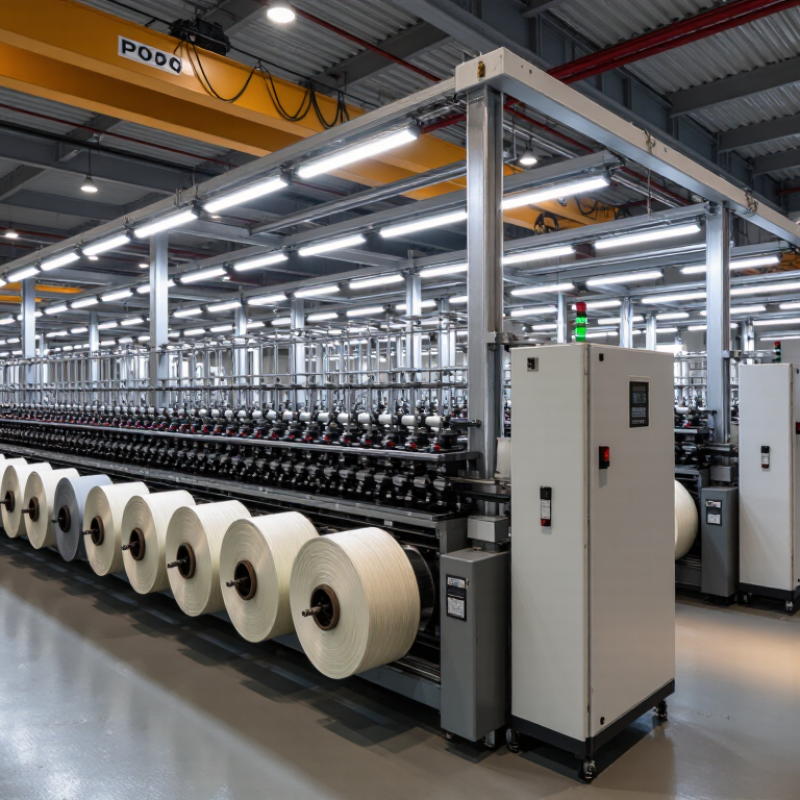
A POY spinning line converts polymer chips into partially oriented yarn for textile production. POY means partially oriented yarn. The process begins with careful drying, because moisture can weaken the polymer during melting. An extruder then melts the chips at a controlled temperature. A metering pump pushes the melt through tiny spinneret holes. Each hole forms one filament. Cool air solidifies the filaments below the spinneret. This cooling zone needs even airflow. Uneven cooling can create inconsistent yarn properties.
After solidification, the filaments pass over guides and godets for controlled stretching. Their speed difference creates partial molecular orientation. A winding unit then collects the yarn onto packages at stable tension. Operators commonly check denier, elongation, tenacity, oil pickup, and package shape. In practical plant trials, small temperature changes can affect dye uptake later. This detail is easy to overlook. When comparing line manufacturers, inspect tension control, filtration design, energy use, and maintenance access. Ask for verified production data, not only brochure figures. No line is perfect. Operators still need training, testing, and regular calibration. A poorly adjusted quench system may produce uneven filament cooling, even with advanced equipment.
Key Components and Processes in POY Spinning Lines
2026 Best POY Spinning Line Manufacturers?
A POY spinning line converts polymer chips into partially oriented yarn through controlled melting, extrusion, and winding. The process begins with chip drying, where moisture must remain low. Excess moisture can cause bubbles, weak filaments, and unstable spinning.
The extruder melts the polymer evenly before a metering pump delivers a steady flow. Melt filters remove small contaminants. The spinneret then forms hundreds of fine filaments. Quench air cools them uniformly, while godet rollers control tension and drawing speed. Intermingling improves yarn cohesion before the winding unit packages the POY. Each component matters. A strong line still fails if temperature, pressure, or air distribution is poorly matched.
Tips: Check the dryer, filter, pump, spinneret, quench cabinet, and winder as one system. Ask manufacturers for tension stability, energy use, output range, and maintenance data. Inspect sample packages, not only brochures. Small vibration can create uneven winding. Do not trust a perfect test report without reviewing long-run performance. Some designs look efficient but make cleaning difficult. A useful factory trial should include startup, speed changes, and filter replacement. Leave room for improvement; even a well-tuned line may need adjustments after installation.
How to Evaluate POY Spinning Line Manufacturers in 2026
How to Evaluate POY Spinning Line Manufacturers in 2026
Choosing a POY spinning line manufacturer requires more than comparing equipment prices. Study its engineering experience with your polymer, denier range, production speed, and local operating conditions. Ask for verified production records from comparable plants. A factory visit can reveal more than a polished presentation.
Examine the complete line design, including extrusion, spinning packs, quenching, winding, automation, and quality monitoring. Request measurable data for energy use, yarn breakage, output stability, and changeover time. Check whether critical components are tested before shipment. Reliable manufacturers explain tolerances clearly and provide practical maintenance schedules. Their engineers should also respond with specific answers, not vague promises. This matters during the night shift.
Tips: Bring your own technical checklist. Compare at least three proposals using identical production targets. Ask for sample yarn, test reports, operator training details, spare-parts availability, and emergency response times. Speak with existing users, but verify their claims independently. A reference plant may perform differently because of raw-material quality or operator skill.
Do not ignore software access and cybersecurity controls. Ask how recipes, alarms, and production data are protected. Review installation responsibilities, acceptance tests, warranty limits, and expected performance after commissioning. Some proposals look complete but exclude utilities, foundations, or training. I have seen small omissions become expensive delays. Leave room for improvement; your first specification may be too optimistic.
2026 Best POY Spinning Line Manufacturers? How to Evaluate Them
A practical, non-brand evaluation framework for comparing POY spinning line manufacturers. The weighting reflects common procurement priorities: stable production, consistent yarn quality, energy efficiency, automation, lifecycle support, and project delivery.
Evaluation weights are benchmark guidelines rather than rankings of individual manufacturers. Buyers should validate performance through reference plants, acceptance testing, energy data, spare-parts planning, and after-sales service agreements.
Leading POY Spinning Line Manufacturers and Their Technologies
In 2026, leading POY spinning line manufacturers are judged by more than machine speed. Experienced suppliers combine stable melt delivery, accurate metering, and responsive technical service. Their lines typically include polymer filtration, precision spinning pumps, cross-flow quenching, and automated winding. Each section affects yarn uniformity.
Process control is becoming more practical. Advanced systems monitor temperature, pressure, denier, and winding tension in real time. Some manufacturers provide digital dashboards that help operators trace defects to specific positions. Energy-saving drives and optimized quench airflow can reduce operating costs without weakening production stability. Small details matter.
Reliable manufacturers also support line trials, installation training, spare-parts planning, and preventive maintenance. Buyers should request test data for breaking strength, elongation, Uster values, and package hardness. A polished brochure is not enough. Factory references and commissioning records offer stronger evidence.
Yet no supplier gets every detail right. A highly automated line may still require skilled operators during polymer changes or unexpected alarms. I would question promises of zero defects. The better approach is to compare verified performance, response time, upgrade flexibility, and long-term service capacity. Manufacturers that explain limitations clearly often prove more dependable than those offering perfect claims.